
To see the full information about the framework, click here.
6.1Core Pedagogical Objectives & Backward Design Architecture
To deliver immersions aligned with your specific curricula and academic priorities, Austral Education Group collaborates directly with university faculty. Utilizing a backward design methodology, we map every company visit, C-suite executive session, and cultural immersion directly to the partner university's core curriculum, learning outcomes, and international accreditation benchmarks, including AACSB and AMBA Assurance of Learning (AoL) standards.
To guarantee that student learning is both effectively realized and accurately evaluated, we created the Learning Impact Framework (LIF). The LIF serves as a comprehensive educational framework that can be integrated into your business immersion program to establish, track, evaluate, and share clear student learning achievements from initial pre-departure orientation to final post-program synthesis.
The Learning Impact Framework (LIF) is a structured educational architecture and methodology designed to wrap around global academic immersions and experiential travel programs. It translates immersive international experiences into verifiable, evidence-based learning outcomes rather than relying solely on subjective post-trip satisfaction surveys.Core Objectives
Below is an overview of the core learning and development objectives that guide our programs, how they are collaboratively established with university partners, and how the LIF systematically tracks and proves student competency growth.
6.1.1Core Learning and Development Objectives
Rather than imposing a rigid, one-size-fits-all curriculum, we align each program’s objectives with our partner university’s academic standards, faculty syllabi, and institutional Assurance of Learning (AoL) criteria (benchmarked against international accreditation standards such as AACSB and AMBA).
Programs are anchored around a Flexible Competency Library where university leadership and faculty select 3 to 5 priority competencies that reflect the academic discipline and desired student outcomes.
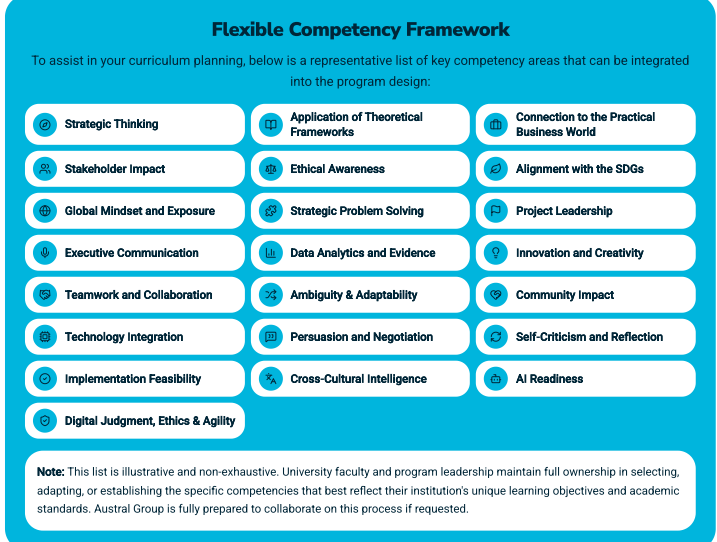
In the screenshot above, you can see how the Learning Impact Framework organizes its competency library—spanning strategic problem solving, cross-cultural intelligence, executive communication, and AI readiness—allowing faculty to maintain full academic autonomy in defining priority learning objectives while mapping directly to AACSB and AMBA Assurance of Learning (AoL) goals.
Our most frequently prioritized student learning and development objectives include:
- Applied Problem Solving & ExecutionDeveloping the ability to bridge academic theory with real-world practice, translating complex frameworks into executable strategies under conditions of market informality and data scarcity.
- Global Mindset & Cross-Cultural IntelligenceDeveloping critical cultural awareness, understanding local socio-economic nuances, and adapting business or academic models to diverse international market realities.
- Critical Thinking & Analytical RigorAnalyzing multi-faceted business and social challenges, interrogating assumptions, evaluating ambiguous evidence, and building data-driven recommendations under executive scrutiny.
- Ambiguity, Agility & AdaptabilityCultivating behavioral resilience and executive presence by responding dynamically to changing operational circumstances, unexpected field constraints, and shifting client priorities.
- Teamwork & Cross-Functional CollaborationMastering high-pressure team dynamics, active listening, distributed project leadership, and constructive conflict resolution within diverse peer groups.
- Executive Communication & InfluenceStructuring professional deliverables, delivering persuasive C-suite presentations, and defending strategic recommendations during live stakeholder Q&A sessions.
6.1.2The Learning Impact Framework (LIF) Architecture
To measure whether these learning objectives are achieved, the LIF establishes a multi-touchpoint longitudinal data collection system. This methodology moves beyond subjective sentiment by triangulating three distinct data sources: student self-assessments, facilitator field observation logs, and corporate executive/sponsor rubric evaluations.
In the screenshots below, you can see the three core touchpoints of the LIF student journey: the T1 Pre-Trip Learning Brief, the T2 Mid-Week Evidence Capture, and the T3 Final Synthesis Evaluation. Designed as a frictionless 5-minute mobile survey, this structure captures real-time data across the program without inducing survey fatigue or detracting from the immersion experience.
The evaluation engine operates across three integrated phases:
- T1 Pre-Departure Baseline Survey (Clarify)Administered before travel, students complete a diagnostic assessing their baseline proficiency across the program’s selected competencies using a standardized 5-point behavioral Likert scale (ranging from Level 1: Emerging / Requires significant guidance to Level 5: Mastery / Executes independently in complex situations).
- T2 Mid-Program Pulse & Daily Facilitator Logs (Capture)Mid-way through the immersion, students complete an agile diagnostic capturing real-time friction, analytical pivots, and unexpected constraints. Concurrently, our on-site program coordinators record daily facilitator field logs to monitor team dynamics and identify early project risks ("red flags") for proactive academic intervention.
- T3 Final Synthesis & Client Rubric Evaluation (Communicate)Upon program completion, students evaluate their growth and articulate how their field experiences translate into long-term career readiness. Simultaneously, external corporate executive sponsors complete an objective rubric evaluating final deliverable quality, presentation delivery, and observable competency performance.
Granular Team Diagnostics & The "In-Field Crucible"
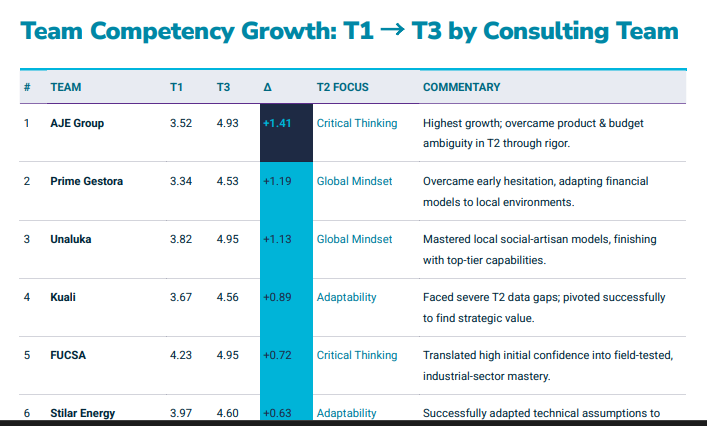
The LIF avoids relying solely on aggregate cohort averages by tracking individual team trajectories and managing operational inflection points in real time. Through the mid-project pulse (T2) and daily facilitator field logs, the framework identifies team-level obstacles—such as severe client data scarcity, scope ambiguity, or stakeholder friction—and provides targeted pedagogical coaching before final deliverables are compromised.
Transferable Employability & Leadership Readiness
The terminal phase of the framework (T3 Final Synthesis) requires students to reflect critically on their performance, identify concrete evidence of their growth, and translate field breakthroughs into professional language. This qualitative synthesis ensures that the international experience directly supports student employability, executive communication, and post-degree career advancement.
3Proven Impact: Rice University Case Example
The pedagogical effectiveness of this framework is best illustrated through real cohort outcomes. In our deliverable report for the Rice University Jones Graduate School of Business (Online MBA Global Field Experience in Lima, Peru), 77 students across 14 consulting teams tackled high-stakes strategic challenges for local corporate clients.
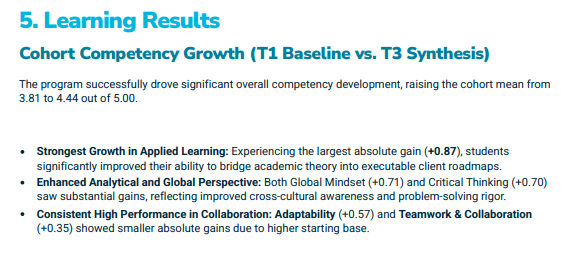
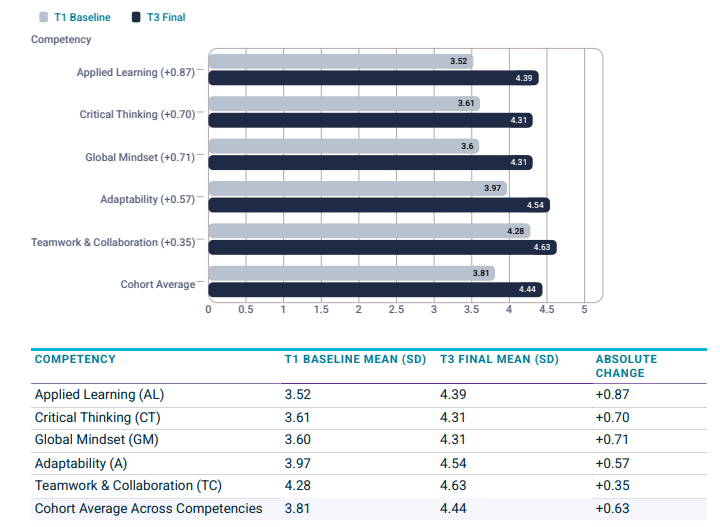
In the screenshots above from the Rice University Learning Impact Report, you can see the measured shift from T1 baseline to T3 completion. Overall cohort proficiency increased from 3.81 to 4.44 out of 5.00 (+0.63 lift), led by substantial gains in Applied Learning (+0.87), Global Mindset (+0.71), and Critical Thinking (+0.70). Furthermore, the comparison highlights the 'In-Person Crucible Lift,' showing that traveling teams achieved significantly higher behavioral mastery in Global Mindset (3.60 vs. 4.31) and Adaptability (4.54 vs. 3.97) compared to remote participants.
Through this quantitative tracking, faculty and academic directors received empirical evidence that the travel immersion acted as a crucible for higher-order behavioral competencies—validating that students moved from requiring guidance in routine situations to executing independently in complex, ambiguous environments.
4External Stakeholder Validation & Career Readiness
A defining feature of our student learning objectives is that they are validated not only by internal reflection, but by the marketplace. By contrasting student self-perceptions against external client assessments, the LIF provides an objective audit of student capabilities.
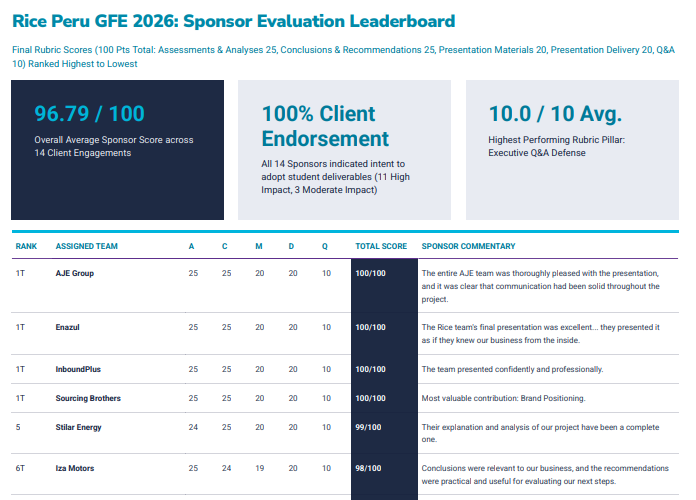
In the screenshot above, you can see the external validation data from the Rice engagement: 14 out of 14 C-suite executive sponsors (100% response rate) evaluated final student deliverables across a 100-point rubric, yielding an average cohort score of 96.79/100. Critically, 100% of corporate partners confirmed their intention to adopt the students' recommendations (78.6% High Immediate Impact, 21.4% Moderate Impact/Testing).
By completing these structured engagements, students achieve concrete developmental milestones that translate directly into career mobility and employability:
- Consulting & Strategic Advisory ProficiencyStudents learn to diagnose ambiguous business ecosystems, formulate hypotheses under extreme data scarcity, and present strategic recommendations to C-level executives.
- Executive PresenceThrough formal client-facing pitches and live Q&A defense sessions, students build confidence communicating complex technical ideas without relying on scripted notes.
- Translating Experience into Career NarrativesThe T3 synthesis prompts students to connect their in-field breakthroughs (such as managing partner misalignment or pivoting commercial models) into concrete interview narratives for leadership roles, promotions, or entrepreneurial ventures.
6.1.5Post-Program Deliverables for University Leadership
Following every program, Austral Group delivers a comprehensive Learning Impact & Program Synthesis Report to faculty and university administrators. This executive deliverable synthesizes:
- Quantitative Competency Growth MetricsPaired longitudinal statistical analysis documenting student growth across all prioritized learning outcomes.
- Stakeholder Alignment & Gap AnalysisSide-by-side comparisons of student self-assessments versus external host evaluations, identifying blind spots or areas of student overconfidence.
- Proactive Red-Flag ResolutionsDocumentation of mid-project challenges identified by T2 pulses and facilitator logs, detailing how on-the-ground interventions steered projects to success.
- Strategic "Keep, Improve, Scale" RoadmapActionable curriculum recommendations to inform subsequent iterations of the academic course.
- Accreditation-Ready DocumentationFormatted evidence suitable for immediate submission to institutional review boards, curriculum committees, and accreditation bodies (AACSB, AMBA, EQUIS).
By embedding the Learning Impact Framework into program design, we ensure your institution can confidently demonstrate to university leadership, trustees, students, and prospective applicants that every academic travel program delivers measurable academic return on investment and transformative student development.
6.3Speaker Quality Process & Executive Selection Criteria
To guarantee that every corporate meeting and guest lecture directly advances these student outcomes, Austral enforces a rigorous, five-stage Speaker Quality Process:
- Academic Scoping3 to 6 months prior to departure, faculty complete our Pre-Trip Academic Planning Survey to define specific module themes, target industries, and desired presentation topics.
- Targeted CRM SourcingProgram Managers query our proprietary Salesforce CRM database—comprising 3,700+ active corporate contacts globally—to identify executives whose professional expertise aligns with the course syllabus.
- Seniority & Anti-Fatigue ProtocolsWe enforce strict speaker selection rules where high-level executives (CEOs, Presidents, VPs, and Directors, who make up over 50% of our booked network) are explicitly reserved for MBA/EMBA cohorts. Additionally, to maintain high engagement and protect relationship quality, no speaker may be utilized more than three times per calendar year (once per trimester).
- Pre-Briefing & Faculty Sign-OffFaculty review and approve tentative itineraries and speaker bios. Confirmed speakers receive detailed briefing manuals outlining the cohort's background and key academic questions to address during the session.
- Continuous Quality ControlFollowing every trip, professors complete the Trip Leader Evaluation, rating speaker quality and relevance. These scores are aggregated into our executive Trip Quality Dashboard, where Austral maintains a strict benchmark objective of 6.5 out of 7 across all meeting categories